
Podcast: Play in new window | Download
Subscribe: Apple Podcasts | Spotify | RSS | More
Welcome to Which Game First where we boldly explore the hilariously huge world of board games. Did we unearth any hidden treasures you’ve been missing out on? Let’s find out!
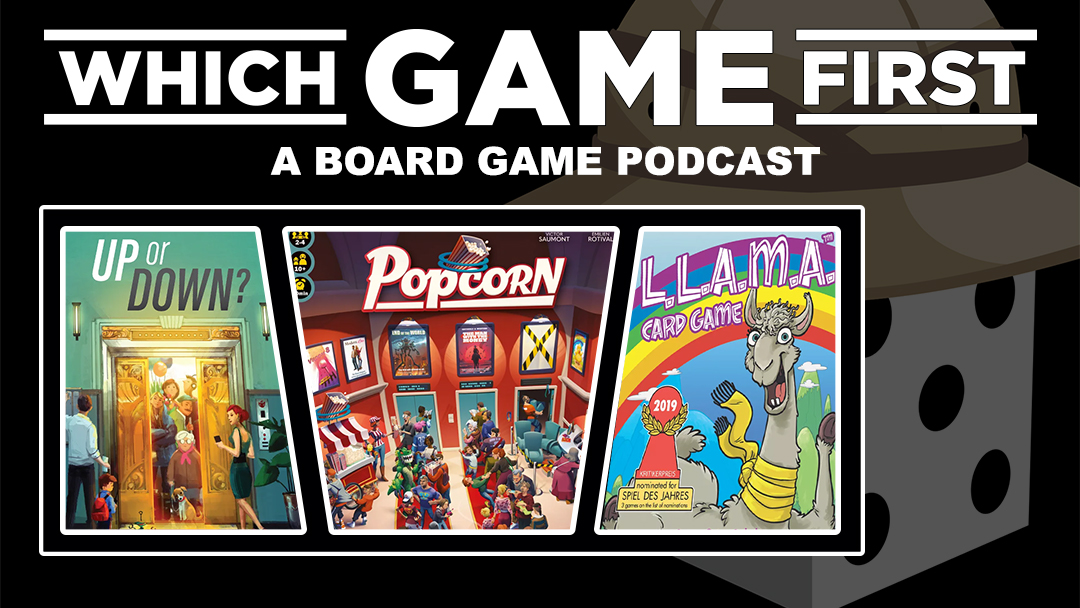
First up: We elevate our spirits and press all the buttons at once in Up or Down?
Next: We navigate sticky floors and lobby doors in Popcorn
And lastly: We shed our cards faster than our fur in L.L.A.M.A.
Up or Down?
Designed by: Michael Kiesling, Wolfgang Kramer
Published by: ABACUSSPIELE and Capstone Games (2024)
Players: 2 – 6
Ages: 8 & up
Playing time: 30 minutes
In Up or Down?, you build ascending and descending rows of cards, trying to place as many cards of the same color in a row as possible
To set up, shuffle the deck, deal each player a hand of three cards, reveal six cards and place them in a ring from low to high, then split the deck in half and place these piles in the center of the ring, one face up and the other face down. The deck contains cards numbered 1-126, although you adjust the deck based on the number of players.
On a turn, place a card from your hand between the surrounding numbers in the ring, e.g., 37 between 34 and 52, then you take one of the cards surrounding your just-placed card and add it to your display, either starting a new row or adding to an existing row. (If your card is lower than the lowest number or higher than the highest, place it between the lowest and highest card, then add one of those cards to your display.)
You can have up to three rows in your display. When you place a second card in a row, you must decide whether the cards in that row will be placed in ascending order or descending, and you stack the cards accordingly. If you cannot or do not want to place a card in a row — following the ascending or descending order you set up — take all the cards in a row of your choice, flip them face down into a personal discard pile, then start a new row with your current card.
To end your turn, draw a card from either pile inside the ring. Once all the cards in the game have been played, score your rows. For each row, multiply the number of cards in that row by the number of cards in the most common color in that row. For each card in your discard pile, score 1 point. Whoever has the most points wins.
Popcorn
Designed by: Victor Saumont
Published by: IELLO (2025)
Players: 2 – 4
Ages: 10 & up
Playing time: 60 minutes
In Popcorn, each player manages their own movie theater and tries to show the best combination of movies in order to attract guests to their seats.
The game plays out over nine rounds, and in each round you may acquire a new movie, build or upgrade your theater, and use advertising to attract new guests — then it’s showtime, with you drawing guests at random from your bag to see who has shown up. Place guests in the right seats to activate special powers; match them with the right movies, and you get a movie bonus as well, thanks to their enthusiasm for your good taste.
After watching films in your theater, guests might be spirited away to other theaters thanks to ads presented by those theater owners – but you’ll probably do the same to them, too.
The bonuses from a movie get worse the longer it runs, so be sure to bring in fresh films to keep guests on the edge of your seats. After all, happy guests can help your theater win awards in town; more importantly, they can keep the “popcorn” piling up in your coffers, and whichever theater owner fills their popcorn box the best wins.
L.L.A.M.A.
Designed by: Reiner Knizia
Published by: AMIGO (2019)
Players: 2 – 6
Ages: 8 & up
Playing time: 20 minutes
In LLAMA, you want to dump cards from your hand as quickly as you can, but you might not be able to play what you want, so do you quit and freeze your hand or draw and hope to keep playing?
Each player starts a round with six cards in hand; the deck consists of llama cards and cards numbered 1-6, with eight copies of each. On a turn, the active player can play a card, draw a card, or quit. To play a card, you must play the same number as the top card of the discard pile or one number higher. If a 6 is on the discard pile, you can play a 6 or a llama, and if a llama is on top, you can play another llama or a 1. If you quit, you place your remaining cards face down and take no further actions in the round. If all players have quit but one, that player can continue to play, but cannot draw more cards.
The round ends when one player empties their hand or all players have quit. In either case, players collect tokens based on the cards in their hand. Each different number card in hand gets you white tokens (each worth 1 point) equal to the value of the card while one or more llamas gets you a black token (worth 10 points). (You can exchange ten white tokens for one black token at any time.) If you played all your cards, you can return one token (white or black) that you previously collected to the supply. You then shuffle all the cards and begin a new round, in which the first player to play will be the one who emptied their hand or was the last one to quit in the previous round.
The game ends at the end of the round where at least one player has forty or more total points. Whoever has the fewest points wins!